

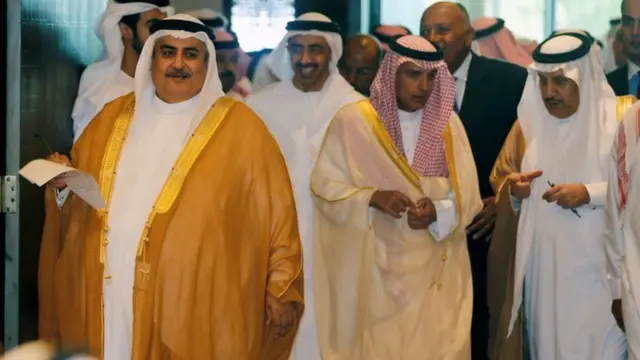
HNN: The Gulf states are urging Donald Trump to continue the war against Iran. At the same time, thousands of American soldiers are flowing into the region.
The United States’ Gulf allies, led by Saudi Arabia and the United Arab Emirates, argue to the White House that the regime in Tehran has not yet been weakened enough after a month of bombing, and that the war should continue.
The information comes from American, Israeli, and Gulf officials who are not authorized to speak publicly, writes Associated Press.
Officials from Saudi Arabia, the UAE, Kuwait, and Bahrain have reportedly said in private conversations that they do not want the military operation to end until significant changes occur in Iran’s leadership or there is a dramatic shift in Iranian policy.
This comes as President Trump alternates between claiming that Iran’s leadership is ready to negotiate and threatening further escalation if an agreement is not reached soon.
So far, the war has cost over 3,000 lives and sent shockwaves through the global economy.
Wants a ground invasion
The UAE has emerged as the most hawkish among the Gulf states and is strongly pushing for Trump to order a ground invasion. The Emirates have faced over 2,300 missile and drone attacks from Iran since the war began, and frustration is growing as the attacks threaten the country’s reputation as a safe and prosperous hub for trade and tourism in the Middle East.
– “An Iranian regime that fires ballistic missiles at civilian homes, uses global trade as a weapon, and supports militias is no longer an acceptable part of the regional landscape,” wrote Noura Al Kaabi, a minister in the UAE’s foreign ministry.
– “We want a guarantee that this will never happen again,” she added.
Kuwait and Bahrain reportedly also support a ground invasion, while Oman and Qatar—traditionally mediators between Iran and the West—prefer a diplomatic solution.
Saudi Arabia argues that a peace agreement now would not provide sufficient security for Iran’s Arab neighbors. It demands that any deal:
- neutralizes Iran’s nuclear program
- destroys its ballistic missile capabilities
- ends support for militias
- ensures Iran cannot close the Strait of Hormuz in the future
Crown Prince Mohammed bin Salman is said to have told the White House that further disarmament of Iran would benefit the entire Gulf region in the long term.
“An apocalyptic vision of the future”
U.S. Secretary of State Marco Rubio supported the unified stance, describing Iran as “religious fanatics who must never be allowed to possess nuclear weapons.”
– “They have an apocalyptic vision of the future. And all their neighbors know this,” Rubio said in an interview with ABC.
Trump also praised Bahrain, Kuwait, Qatar, Saudi Arabia, and the UAE for showing “courage” in the conflict, and described Mohammed bin Salman as a “warrior” and a “fantastic man.”
Military buildup
As talks continue, the military presence is increasing. Thousands of soldiers from the U.S. 82nd Airborne Division have begun arriving in the Middle East, two U.S. officials told Reuters. About 2,500 Marines arrived in the region over the weekend alone.
The forces include headquarters units, logistics and support personnel, and one brigade combat team. No decision has yet been made to send troops into Iran, but the buildup is intended to increase capacity for possible future operations.
Since operations began on February 28, the U.S. has struck more than 11,000 targets. More than 300 American soldiers have been wounded and 13 killed as part of Operation Epic Fury, according to the news agency.
The Trump administration is considering several possible military operations inside Iranian territory. One option is an attempt to take control of Kharg Island, the hub for 90% of Iran’s oil exports. Such an attack is described as highly risky, as Iran can reach the island with missiles and drones.
Trump said Monday that the U.S. is negotiating with a “more reasonable regime” to end the war, but repeated a warning to Tehran to open the Strait of Hormuz, or risk attacks on oil fields and power plants. The deadline is set for April 6.
Heemaal News Network